
The cannabis consumption devices sector has expanded dramatically as consumers seek healthier and more convenient ingestion options alongside the progression of cannabis legalization.
In the illicit sector, product suppliers had no incentive to offer varied consumption options as consumers were forced to purchase whatever was brought to market. In the legal market, however, competition and innovation have rapidly expanded the ways in which cannabis can be consumed.
Vaporizers have become a leading method by which cannabis is consumed due to portability, convenience and health implications. Rather than having to light a joint, glass pipe or other old-school device and inhale combusted cannabis as smoke while simultaneously putting off strong cannabis odors, vaporizer users can simply press a button and inhale nonsmoke vapor with less cannabis smell. Additionally, the act of vaporization limits the amount of nonactive ingredients and combustion byproducts inhaled by the user, leading to a relatively healthier experience.

Eaze, a leading cannabis delivery application based in San Francisco, reported that users of its platform increasingly ordered vaporizers through 2018. This trend was further supported by cannabis market intelligence firm BDS Analytics, which reported that the market share for marijuana concentrates increased from 10% of all products sold in 2014 to 27% in 2018, with most of those sales being prefilled vaporizers.
Beyond Distribution: Product Creation, Sophistication Gaining Ground
Many of the early vaporizers in the cannabis industry were simply purchased wholesale from factories in China, most of which had been developed for inputs such as nicotine e-liquids—not cannabis. However, as competition has increased between hardware providers and users seek more advanced offerings from vaporizer providers, firms in the consumption devices industry must find ways to differentiate themselves from their peers.
The implementation of advanced materials and technologies has been utilized by several providers.
For example:
- Ceramics resist the stresses of high temperatures and are relatively nonreactive with the compounds in the vaporizer.
- Manufacturers are also experimenting with various types and designs of heating apparatuses that use different materials to provide consumers with greater choice in experience.
- Various technologies that provide additional functionality.
More recently, companies have begun offering full enterprise solutions around vaporization hardware, assisting licensed operators in navigating the engineering, design, procurement and marketing of their various offerings.
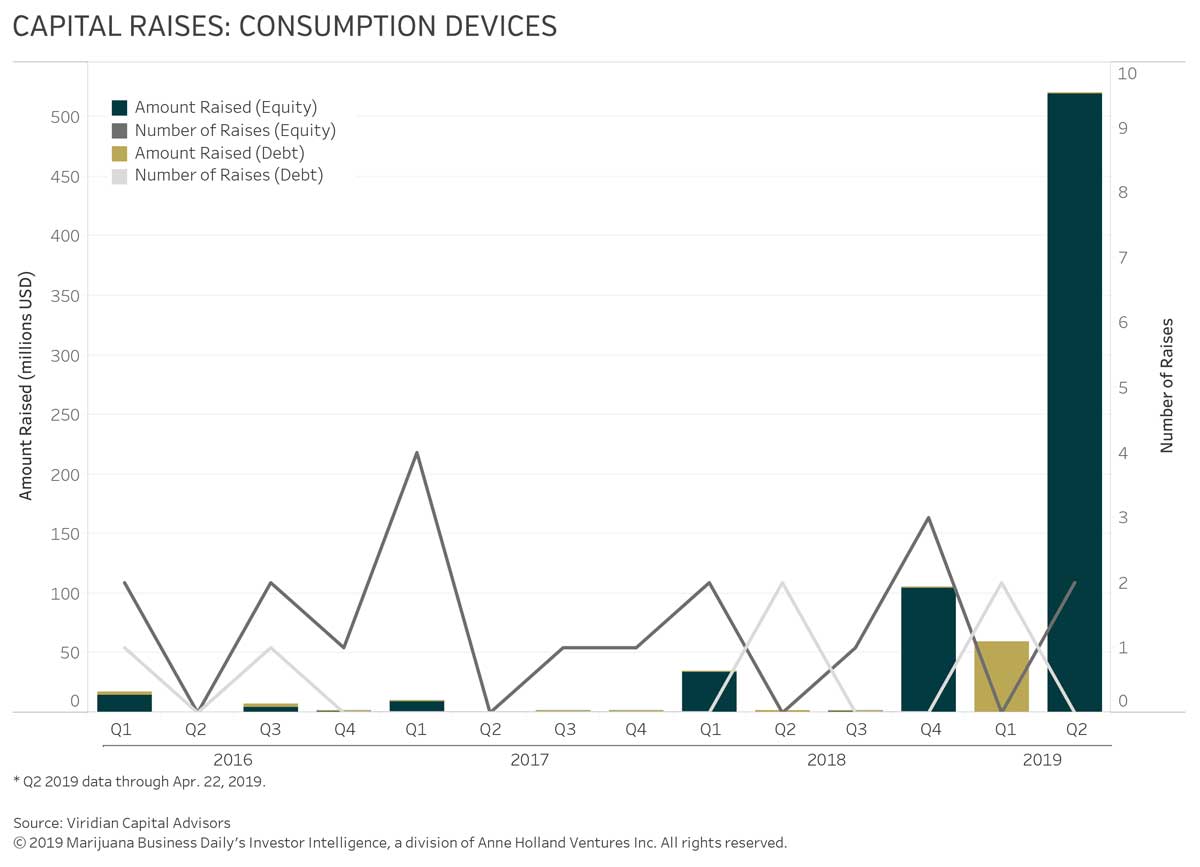
Capital raises in the consumption devices space have remained much lower than in other sectors, though we have seen a small number of companies successfully raising funds because of differentiation from e-commerce or rollup strategies. Consumption device companies focusing on developing novel technologies have been more successful.
Several publicly traded consumption device companies focusing on e-commerce sales and distribution raised much of the capital through the middle of 2018. Private companies in this sector have focused on developing novel technologies, included metered-dose inhalers, tech-enabled vaporization devices and new methods for temperature and airflow controls.
Capital-raise activity in this sector increased dramatically in Q2 2019 with Greenlane Holdings of Boca Raton, Florida, completing a $102 million IPO onto the Nasdaq (after a $48 million convertible note financing closed in January 2019) and Pax Labs of San Francisco closing a $420 million private round.
Mergers & Acquisitions
Most of the M&A activity we have tracked in the consumption devices sector has been related to product creation and intellectual property or reach.
Additionally, cannabis companies buy into this sector for advanced technologies. Canopy Growth Corp. acquired Storz & Bickel, the manufacturer of Volcano brand vaporizers, for up to CA$220 million in cash, specifically citing the desire to use Storz & Bickel’s expertise to enhance Canopy’s product development capabilities.
Cannabis companies, both inside and outside this sector, have purchased consumption device companies to gain access to their customer base and bolster their scale. Cambridge, Massachusetts-based Tilt Holdings, for example, acquired Jupiter Research, a vaporizer manufacturer and distributor, for $210 million.
We expect these types of deals to continue as consumers demand more advanced hardware options.
Valuations
There are few publicly traded pure-play cannabis consumption device companies, limiting the availability of valuation metrics. However, as these companies are essentially hardware manufacturers and distributors, they tend to trade at lower valuations than cannabis companies that are “touching the plant.” We have seen deals done at low-single-digit multiples related to trailing revenues.
However, that is not to say firms in this sector will not be able to command premiums for their technologies, intellectual property or more profitable niches. Many operators in this sector face substantial competition, putting pressure on margins and, subsequently, valuation multiples.
Harrison Phillips is vice president at Viridian Capital Partners.