
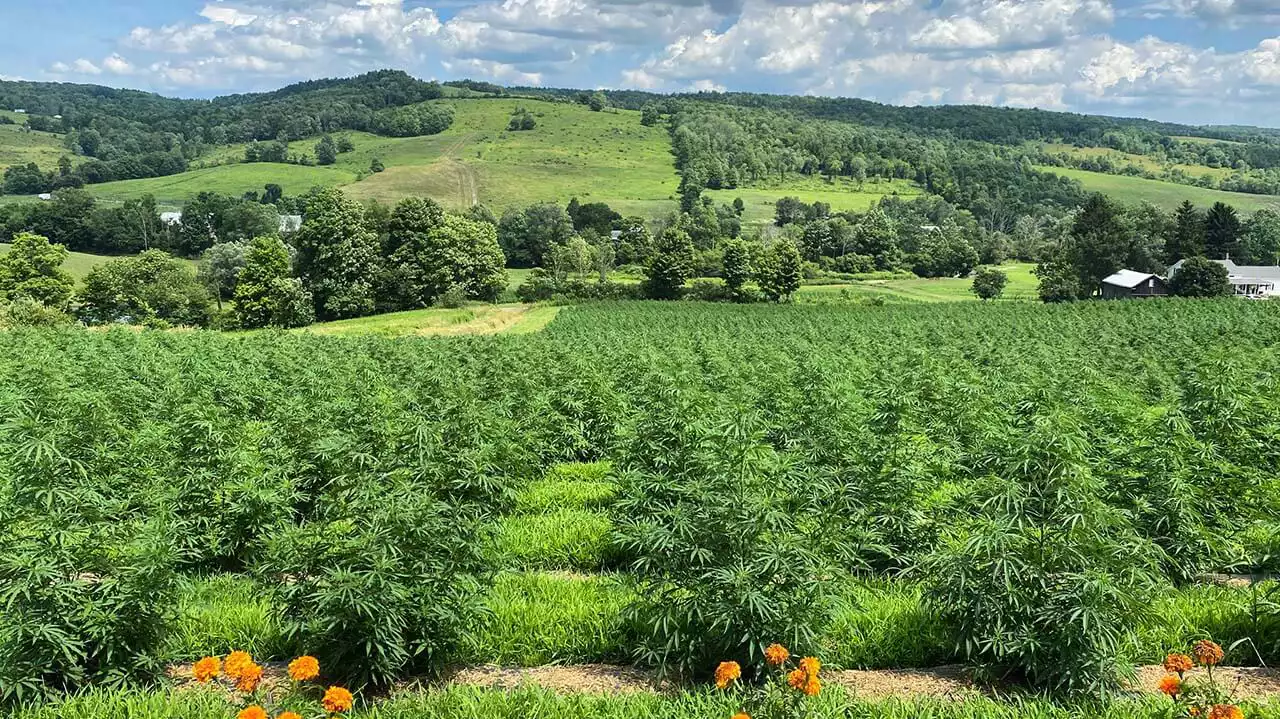
The clock is ticking for hemp farmers like Ryan Eakes.
The chief operating officer of Montrose, Colorado-based Typhoon Farma is preparing to plant 220 acres of CBG-dominant hemp – but with the hemp industry in a state of uncertainty ahead of a change in federal law, he still hasn’t secured a buyer.
After planting 320 acres last year, Eakes entered 2026 expecting to secure a contract with a large processor eager to buy the CBG-dominant hemp plants that he says are more difficult to grow.
But thanks to a federal ban on nearly all hemp-derived cannabinoids due to take effect in November, once-plentiful opportunities for farmers have all but vanished.

“We usually had our pick of the litter on those contracts, and they’re 95% gone now,” Eakes told MJBizDaily.
Hemp farmers across the U.S. are in similar difficult positions on the eve of the 2026 planting season. As efforts in Washington to extend the deadline for when hemp is redefined under federal law stall, a ripple effect is felt throughout the the $28 billion U.S. hemp industry.
But farmers may be the first to feel the pain.
After a promising start, is the hemp industry now in jeopardy?
Dylan Raap, CEO and founder of Vermont-based intoxicating hemp beverage business Upstate Elevator, recalls the early days of the hemp boom after the 2018 Farm Bill removed hemp from the Controlled Substances and legalized hemp cultivation nationwide.
“We started with an acre, then moved to 5 acres and eventually contracted with local farmers for 20 acres,” Raap said.
“In those days, it was a wonderful experience for farmers in Vermont.”
More recently, Raap contracted with larger hemp operations in Oregon amid competition that boxed out small farmers as legal hemp became an agricultural commodity like corn or soybeans.
But the current regulatory uncertainty has left farmers hesitant to plant entirely, he said.
“Hemp gets planted when contracts are in place, and those contracts are not getting signed,” Raap said. “We’re not signing contracts.
The U.S. Department of Agriculture’s annual hemp report is released in April, so the ban’s impact isn’t yet quantified. But according to Raap, “We’re hearing a lot less acreage is being planted.”
“Farmers don’t even know whether it makes sense to buy seeds.”
Is the hemp supply chain on the brink?
The uncertainty may start with farmers, but the federal hemp ban is creating a supply shock rippling through the entire hemp ecosystem.
“It’s a dynamic situation we’re trying to figure out in real time,” said Pat Farrell, CEO of Montana-based crude processor Big Sky Scientific.
“We don’t feel comfortable asking farmers to grow in the current legislative environment,” he said
“We’re confident we’re going to get a fix – we just don’t know when.”
But some processors are encouraging farmers to proceed with planting regardless so that the industry doesn’t face a supply crunch in the fall when the existing inventory of distillates runs out ahead of the November ban.
“Extraction labs will run below capacity, there will be ingredient shortages, and prices will spike,” Raap said.
Who’s to blame for the plight of US hemp farmers?
Jay Grundy is a fifth-generation farmer who’s been growing for Kentucky-based THC product maker Cornbread Hemp. He phased out tobacco after the Farm Bill.
Hemp, he said, gave his farm an opportunity to be profitable.
Now Grundy, whose grandfather held fundraisers for longtime retiring U.S. Sen Mitch McConnell in his home, blames the retiring McConnell for the timing of the ban.
President Donald Trump signed a spending package with the hemp redefinition included – pushed by McConnell, a Farm Bill architect – in November, at the tail end of the 2025 harvest season.
Grundy said hemp crop expenses are incurred from May through October.
With the November announcement, he and other farmers haven’t been able to move biomass because processors won’t take it on.
McConnell “allowed all these farmers to go into debt throughout the year, and we come to the finish line without debate and without a vote – he pulled the rug out from under the farmers,” Grundy said.
“The timing was almost a slap in the face to the farmer.”
Hemp farmers see costs grow without market guarantee
Grundy recently spent $250,000 on a facility to store his crops – an investment he would not have made had the ban been announced in early 2025.
“Now I have to find a way to pay for it,” Grundy said. “The initial concern is how do I get out from underneath this debt, or did I just strap myself to a loan payment for 20 years?”
“We’re not asking for a government bailout; we’re asking for sensible regulations,” he added.
“We’ve made capital investments that we now have to find a way to pay for. It’s a trickle-down economy, and this affects everyone from farmers to local vendors.”
Has Congress fixed the hemp ban with a new Farm Bill?
Help from Washington hasn’t appeared.
An amendment to the 2026 Farm Bill introduced in January by U.S. Republican Rep. James Baird proposed a two-year delay. But with House Agriculture Chair Glenn “GT” Thompson steadfast that the hemp ban issue is beyond the Farm Bill’s jurisdiction, it was excluded.
That’s leaving stakeholders scrambling for alternative legislative solutions. A bill introduced in January by U.S. Rep. Morgan Griffith, a Virginia Republican, and U.S. Rep. Marc Veasey, a Texas Democrat, would create a federal regulatory framework for hemp. But the bill hasn’t advanced.
“We’re crying out for regulation at this point,” Raap said. “Farmers can’t be held hostage by federal uncertainty. The time is now to get some kind of insurance or relief.”
Subscribe to the MJBiz Factbook
Exclusive industry data and analysis to help you make informed business decisions and avoid costly missteps. All the facts, none of the hype.
What you will get:
- Monthly and quarterly updates, with new data & insights
- Financial forecasts + capital investment trends
- State-by-state guide to regulations, taxes & market opportunities
- Annual survey of cannabis businesses
- Consumer insights
- And more!
The uncertainty has already led many farmers to abandon hemp altogether.
US farmers are ditching hemp amid ban uncertainty
Last spring, Eakes planted 320 acres. Uncertainly created by the ban already led him to cut his 2026 plans to 220 acres – meaning he’s had to lay off 10 employees.
But if Typhoon doesn’t get the contract Eakes is anticipating by March 28, he’ll only plant 15 acres – and he’ll have to let his remaining 35 employees go.
He’ll also be out the roughly $500,000 that he spends on inputs like soil and nutrients.
“If we don’t plant, that’s money that’s not going into our local community,” Eakes said.
Eakes said none of the other farmers in the Uncompahgre Valley, where Montrose is located, are planting hemp crops this year.
“The first couple of years, people were willing to gamble, but they’re not going to gamble again,” he said.
Margaret Jackson can be reached at margaret.jackson@mjbizdaily.com.