Key points:
- A new federal program to provide up to $500 a year to cover hemp-derived CBD products for eligible seniors on Medicare launched in April but appears stalled out.
- Only a select few healthcare providers and hemp companies are participating in the Center for Medicare and Medicaid Services’ “Substance Access Beneficiary Engagement Initiative.”
- The federal hemp CBD reimbursement program, announced by President Donald Trump in December, is at risk unless the federal hemp ban is modified to keep products legal.
Six months after the launch of a Trump administration program that promised seniors free hemp-derived CBD products, the effort appears stalled in large part because of the looming federal ban on most hemp cannabinoid products.
Only six “accountable care organizations” – networks of doctors and hospitals that share care and costs for a group of Medicare patients – out of 74 in the U.S. are approved to offer hemp CBD products, a spokesperson for the federal Centers for Medicare & Medicaid Services told MJBizDaily. And CMS did not say how many of the six are giving products to patients.

Patients in New York and Florida started receiving products in May. But none of the hemp companies lined up to supply the program has reported revenue from it, according to an MJBizDaily review of public filings.
Frustrated would-be suppliers and hemp advocates say the Substance Access Beneficiary Engagement Incentive, embraced by President Donald Trump and CMS Administrator Mehmet Oz thanks to the efforts of a Mar-a-Lago Club member, is dead on arrival until Congress makes sure products can stay on shelves after Dec. 11.
That’s when new federal rules banning most hemp-derived THC products take effect. Many of the products in the program will become banned controlled substances.
The health care groups are waiting on Congress before they spend any money on hemp products that could soon become illegal, said Jim Higdon, co-founder of Louisville, Kentucky-based Cornbread Hemp, which signed on in March as the exclusive hemp supplier to a purchasing group that works with these organizations.
“No one’s going to start a program a couple months before it has to wind down,” Higdon said. “The ACOs and the hospital groups are waiting for Congress to do its job before they get involved.”
CMS, he said, “has done its job.”
Are seniors getting free CBD products thanks to President Donald Trump?
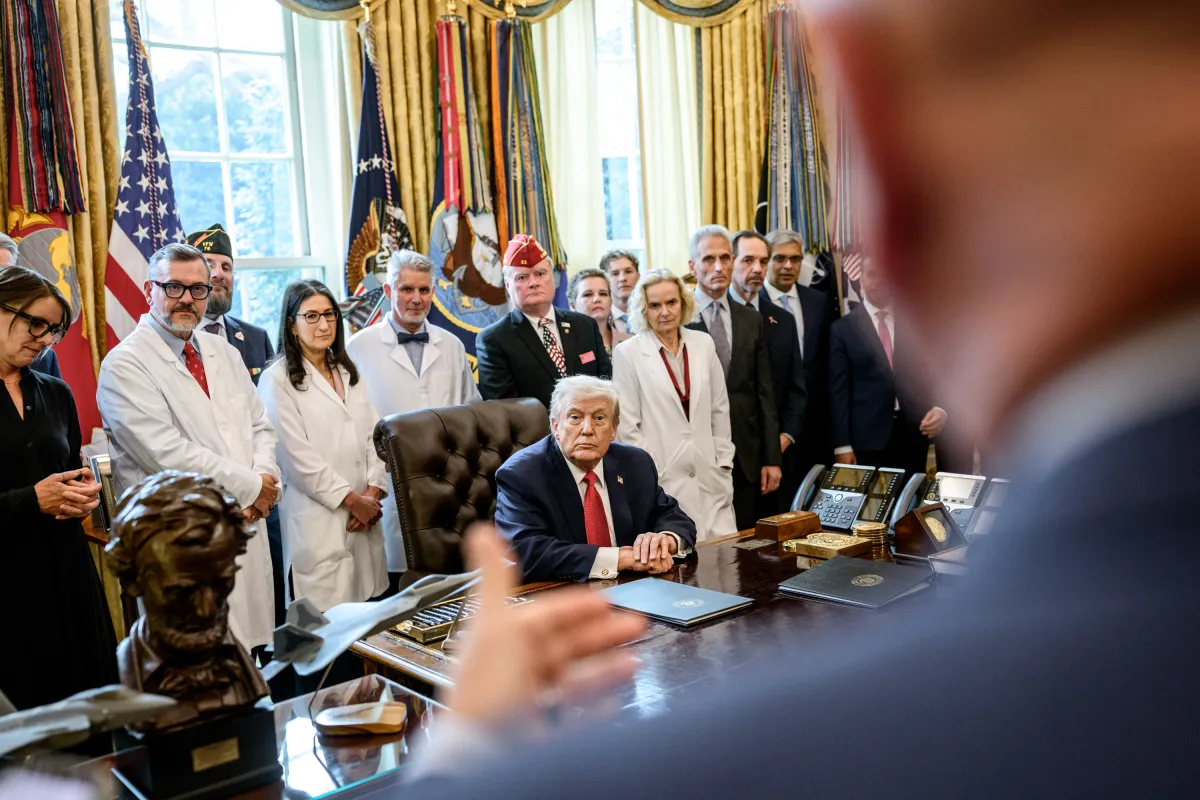
Trump announced the program last December at the White House, the same day he issued an executive order directing federal marijuana rescheduling. It began April 1.
Medicare doesn’t pay for the products. An ACO buys them out of its own budget, up to $500 per patient per year, and a clinician hands them out.
“One of the biggest misconceptions is that Medicare now ‘covers CBD.’ It does not,” said Sasha Kalcheff-Korn, executive director of Realm of Caring, a Colorado Springs, Colorado-based nonprofit that supports patients in the program.
Products can have no more than 0.3% delta-9 THC and 3 milligrams of THC per oral serving and must be tested by a third party. Products
All six approved groups are in ACO REACH, a CMS model with 74 ACOs serving an estimated 1.7 million people in traditional Medicare.
No physician practices in the Enhancing Oncology Model, the other eligible model, applied to offer the products, the CMS spokesperson said.
Six participating ACOs is an increase from five in May, when CMS told The New York Times that patients had started receiving products.
ACO REACH ends Dec. 31. LEAD, the model replacing it, picks up the incentive Jan. 1, 2027, with the same $500 cap and product standards so far.
Are hemp companies supplying CBD products to Medicare?
Charlotte’s Web Holdings, a Louisville, Colorado-based CBD company that works closely with Realm of Caring, reported no program revenue in the second quarter in its public filings. During an August earnings call, the company said the program “remains in early build-out among participating organizations.”
Though its CBD Clinic website now markets straight to ACOs with a catalog of eligible products, Charlotte’s Web said it can’t share anything until it reports third-quarter results.
“To date, no Medicare beneficiaries have been referred to or enrolled in (Realm of Caring’s) support services as a result of the Substance Access BEI,” Kalcheff-Korn said.
Charlotte, North Carolina-based cbdMD also reported no program revenue. The only Medicare item in its August results was about $200,000 in professional fees, grouped with merger and other costs.
cbdMD did not respond to questions about orders.
Cornbread Hemp, which makes CBD products and hemp THC beverages, signed in March as exclusive hemp supplier to Alliant Purchasing, which the company says serves 68,000 provider locations.
Higdon declined to say whether Cornbread has received orders.
High Tide, a Calgary, Alberta-based cannabis retailer that owns CBD brand NuLeaf Naturals, said NuLeaf is in talks with three of the initial ACOs but has no supply agreements.
“Not yet,” said Omar Yar Khan, High Tide’s chief communications and public affairs officer. “The opportunity remains at the business-development stage.”
Does the federal hemp ban outlaw CBD products eligible for Medicare reimbursement
The federal redefinition of hemp passed last November outlaws finished products with more “than 0.4 milligrams (of THC) combined total per container.”
Congress pushed the effective date from Nov. 12 to Dec. 11 in September’s stopgap spending bill.
That means products intended for the program will soon become contraband. Charlotte’s Web’s ACO catalog lists a sleep gummy with 2.5 milligrams of THC per serving and another gummy with 1 milligram.
CMS said eligible products must meet the delta-9 limit “or any future statutory limits,” so a product that loses hemp status loses program eligibility.
“The CMS program simply cannot work if the 0.4 mg/container requirement goes into effect,” said Jonathan Miller, general counsel for the U.S. Hemp Roundtable.
Most CBD products on the market have more than 0.4 milligrams of THC per container, he said.
High Tide is getting ready with THC-free products.
“We have been developing broad-spectrum products for more than three years,” Khan said. Broad-spectrum products keep other hemp compounds but have the THC taken out.
Will Congress or President Trump step in to save the hemp CBD reimbursement program?
Miller is optimistic Congress will act before Dec. 11. Federal funding also runs out that day, which makes the next spending bill the likeliest vehicle for another hemp reprieve.
Other federal lawmaking efforts are stalled.
The Lawful Hemp Protection Act, introduced in July by Rep. Andy Barr, a Kentucky Republican, and Rep. Angie Craig, a Minnesota Democrat, would repeal the container cap, set a 1% total-THC limit for hemp and let the FDA set serving limits, with a 5-milligram default for oral products. It would also write the Substance Access incentive into federal law.
The bill is still in committee.
The program also faces a court fight. Smart Approaches to Marijuana, an anti-legalization group, sued in March along with MMJ International Holdings, a company developing cannabinoid drugs through the FDA approval process.
A federal judge dismissed the case May 22 for lack of standing without ruling on whether the program is legal. Final briefs in the appeal are due Dec. 16 at the U.S. Court of Appeals for the D.C. Circuit.
The group’s CEO, Kevin Sabet, has called the program “taxpayer funded marijuana.”