
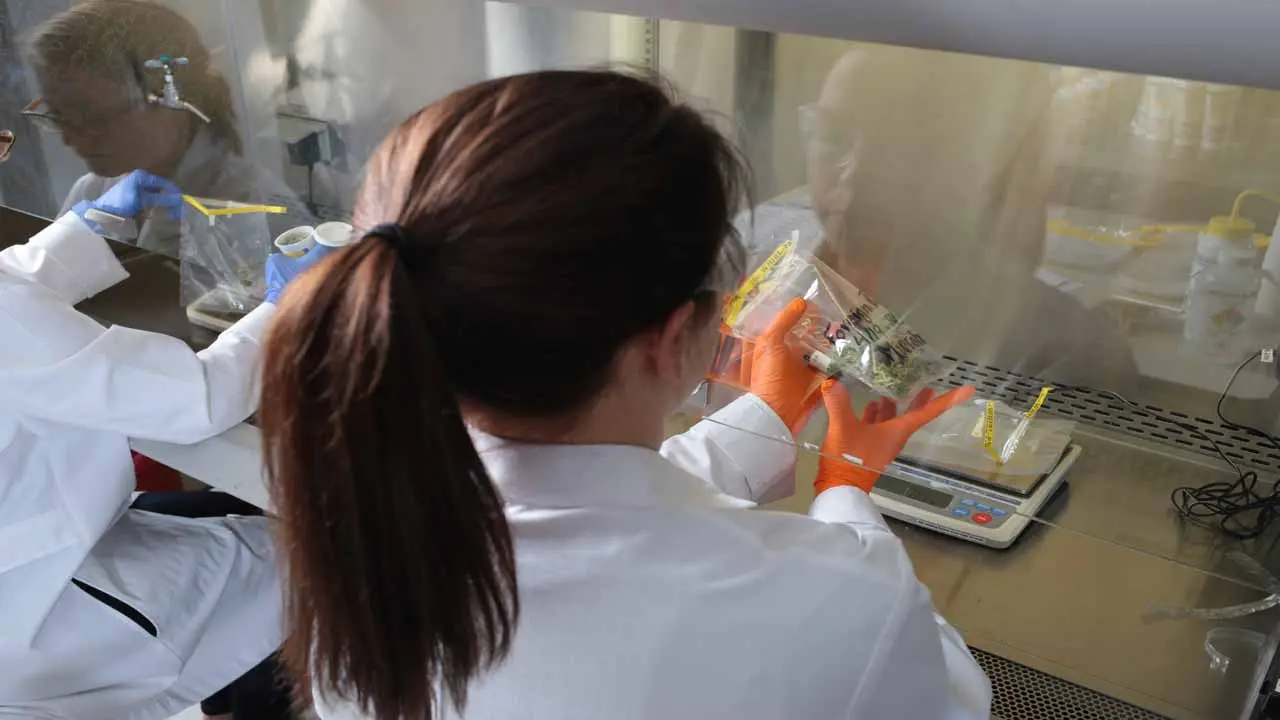
A promised crackdown on THC potency inflation in Massachusetts’ $1.7 billion cannabis market yielded more than a dozen instances of mislabeled flower products, state regulators said Thursday.
Out of 63 cannabis flower products tested by the state Cannabis Control Commission during an “ongoing” shelf audit first announced in May, CCC investigators found 13 that tested outside of an acceptable range, the agency said.
Massachusetts state law allows for a variance of between 75% and 125% of THC content printed on a product label. That means cannabis flower that’s labeled at 20% THC would have to test between 15% and 25% THC to avoid enforcement.
Products that test outside of that range received a “red notice” requiring further action, according to the CCC.

Regulators “placed holds on the noncompliant products to prevent further sales,” the CCC said in a statement Thursday.
Producers must now either:
- Retest the product
- Recall the product and “repurpose” it, which requires new testing
- Recall the product and relabel it with the result found during the audit
- Destroy the product
Did Massachusetts cannabis regulators find THC potency inflation?
The CCC did not immediately identify the product cultivators or manufacturers – or the labs that returned THC potency results later found to be outside of the acceptable range. That information will be posted on the CCC’s website at an unspecified future date, a spokesperson told MJBizDaily.
In a statement, CCC Chair Chris Harding said that the agency “has a responsibility as a regulatory and consumer protection agency to ensure product labels are accurate.”
“This is also a matter of health and safety for medical marijuana patients who rely on potency for accurate dosing,” he added.
“This audit represents a step forward in our efforts to enhance our oversight to maintain trust in the adult-use and medical marijuana markets.”
Is THC potency inflation still a problem in the cannabis industry?
Cannabis cultivators and retailers in Massachusetts and beyond have long said that consumers gravitate toward higher-potency products and that high-quality flower, despite terpene content and overall effect, will not sell if it tests below 20%.
Critics have said these market forces – combined with regulators’ slow response – contributed to the cannabis industry’s widely documented “lab shopping” phenomenon, in which cannabis testing labs deliver results to please clients to attract or retain business.
In response to these critiques, state regulators have slowly begun adopting control measures such as random audits like Massachusetts’.
But concerns extend beyond THC potency inflation to allegations that labs are allowing products contaminated with pesticides and mold to be sold at retail.
In a statement, CCC Executive Director Travis Ahern said that the agency’s ongoing audit program will “move toward random testing for contaminants of concern, including pesticides, heavy metals, yeast and mold, and bacteria.”
Subscribe to the MJBiz Factbook
Exclusive industry data and analysis to help you make informed business decisions and avoid costly missteps. All the facts, none of the hype.
What you will get:
- Monthly and quarterly updates, with new data & insights
- Financial forecasts + capital investment trends
- State-by-state guide to regulations, taxes & market opportunities
- Annual survey of cannabis businesses
- Consumer insights
- And more!
What is being done about THC potency inflation?
Lab watchdogs contacted by MJBizDaily praised the CCC for taking action while noting that the 25% variance was considered loose.
“Many (independent testing lab) operators believed that this process was too generous to fail any products,” Jeff Rawson, the chair of the Institute of Cannabis Science and a frequent critic of lab test results, told MJBizDaily in an email on Friday.
“Instead, we see that 13 out of 63, or around 20%, of products failed,” he added, calling the consequences imposed by the CCC “significant.”
Rawson added: “I believe that brands in this state will be forced to adjust quickly to this new risk.”
Past crackdowns on allegedly unscrupulous testing labs have had erratic results.
In Massachusetts, one lab, briefly shut down by regulators last year after recording a yeast and mold failure rate 90 times lower than the state average, was allowed to reopen.