
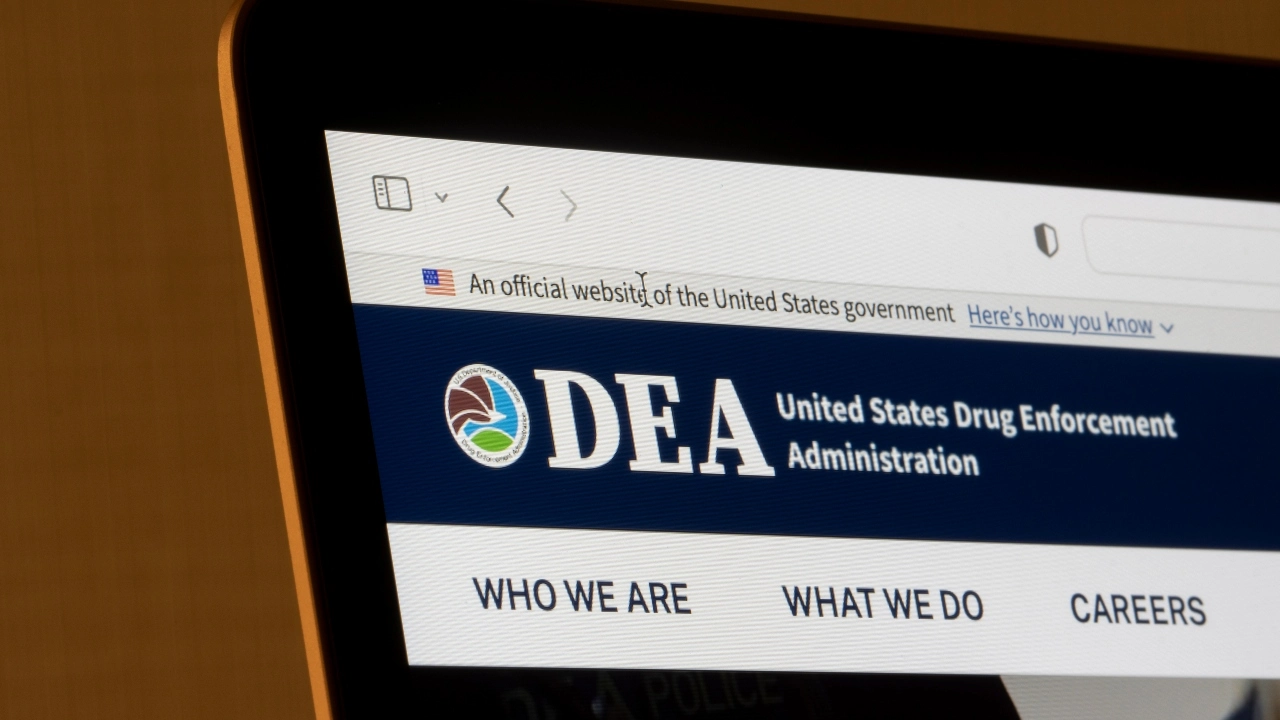
The U.S. Drug Enforcement Administration has never been so popular with the American cannabis industry.
Two weeks after the federal drug police opened a registration portal for state-licensed cannabis businesses following the April 23 final order relaxing federal restrictions on medical marijuana, operators big and small are racing to file their DEA paperwork, MJBizDaily has learned.
That’s despite the lingering ambiguity around exactly what the benefits DEA of registration will be – including unanswered questions around interstate and international commerce – and how they will be felt by operators with both adult-use and medical cannabis permits.
But for now, the potential benefits outweigh any risks, operators and attorneys contacted for this story said.

“It’s all about managing risk,” said Darren Story, a licensed cannabis cultivator in Santa Cruz County, California.
Story signed up nearly immediately after the portal opened on April 29, less than a week after the Justice Department downgraded state-permitted medical marijuana to a Schedule 3 drug.
Registering with the DEA proved both straightforward and popular, he told MJBizDaily.
“We’ve always been 100% medical so for us it was relatively easy to provide the required documentation,” he said. Other colleagues in the industry have also filled out the forms, which involve volunteering sensitive information to the feds, he added.
What is the DEA medical marijuana registration process?
As part of Acting Attorney General Todd Blanche’s April 23 final order downgrading U.S. Food and Drug Administration-approved cannabis products and state-licensed medical cannabis to Schedule 3 of the Controlled Substances Act, the DEA set up a registration portal “for entities holding state medical marijuana licenses.”
According to the DEA, registration enables “such entities to engage in the manufacture, distribution, and/or dispensing of marijuana for medical purposes under federal law consistent with the requirements of” international drug-control treaties.
Initially open just to dispensaries, the DEA earlier this week indicated that registration will also be available for cultivators, manufacturers, labs and distributors “in the coming weeks.”
Businesses who register within a 60-day window that closes on the eve of hearings that could “fully reschedule” cannabis, set for June 29, are promised “expedited review” of their applications, according to the DEA.
For now, DEA registration appears to be optional for most operators, though that may be quickly changing.
Is DEA medical cannabis registration required?
On May 8, Oklahoma regulators instructed license-holders in that state to obtain DEA registration or potentially risk losing their state permits next year.
That’s one potential indicator that the risk of not registering may be the deciding factor, said attorney Charles Alovisetti, a partner at Vicente LLP.
Another is whether DEA registration will be required to seek relief from Internal Revenue Service Code Section 280E, which forbids normal business deductions, in either the current or past tax years.
The U.S. Treasury Department is on notice to provide further guidance at a unknown later date.
Until then, “(F)or a purely medical operator, I think there is more at stake,” Alovisetti said.
“DEA registration is likely your strongest basis for claiming you’re operating consistent with the CSA, and that claim matters for exchange listing, institutional capital raising, interstate commerce participation, and access to the broader financial system.”
Which cannabis companies have registered with the DEA?
That seems to be the attitude in c-suites at major marijuana multistate operators, which have so far been eager to register.
Major publicly traded companies to publicly announce their filing for DEA registration include:
- New York-based MSO Curaleaf Holdings, which said in quarterly filings it is seeking to register “certain medical cannabis locations with the DEA”
- Chicago-based Green Thumb Industries
- Tallahassee-headquartered Trulieve Cannabis Corp, the largest operator in medical-only Florida’s market
- California-based Glass House, which operates major cultivation operations as well as retail
- California-based mega cultivator Leef Brands
In the case of Leef, which reports to be profitable, registration is “a key step” towards participating in “potential interstate commerce and international export channels as regulatory frameworks evolve,” the company said in a May 8 statement.
“For the first time in this industry’s history, federal policy is moving in a direction that makes what we do more valuable, not less,” CEO Micah Anderson said.
For Story, his state-licensed company, Coastal Sun, holds both medical and adult-use distribution permits, according to state data.
Story said he “figured it was worth” the $794 registration fee in part since he’s planning to expand his company’s operations into retail.
The DEA’s initial instructions “said it was for dispensaries but the language was vague so we did it anyways,” he told MJBizDaily.
Subscribe to the MJBiz Factbook
Exclusive industry data and analysis to help you make informed business decisions and avoid costly missteps. All the facts, none of the hype.
What you will get:
- Monthly and quarterly updates, with new data & insights
- Financial forecasts + capital investment trends
- State-by-state guide to regulations, taxes & market opportunities
- Annual survey of cannabis businesses
- Consumer insights
- And more!
Can medical marijuana rescheduling rescue medical cannabis sales?
It’s still unclear whether medical-only rescheduling may be enough to rescue the flagging medical cannabis sector, which has seen huge sales decreases in states where adult-use is available.
In response to the registration requirement, California regulators “streamlined the process” for operators to switch their licenses to medical only designations or to add medical to their adult-use permits, but exactly where a company can draw the line between the two sectors for tax purposes remains unclear.
That said, the DEA’s move “certainly won’t hurt” the medical cannabis industry, said Jesse Alderman, a Boston-based attorney with the law firm Foley Hoag, though time will tell whether it provides advantages compared with those operating in the adult-use sector.
“If and when broader rescheduling is completed, then the same market dynamics as today likely will hold,” Alderman said.
“If for any reason broader rescheduling does not occur, medical cannabis instantly has a host of new advantages.”
And the “most tangible” benefit is 280E relief. Publicly traded cannabis companies have reported $1.6 billion in “uncertain tax positions,” a term for monies the IRS believes it is owed that the companies have declined to pay.
“For a company operating in a state like Florida or Pennsylvania, which are large medical-only markets, the potential tax savings prospectively are tremendous,” Alderman said.
So are the potential risks if a medical operator decides against registration, and later Treasury guidance appears indicating that registration is necessary for 280E relief, Vicente’s Alovisetti warned.
“If guidance suggested registration was needed, and the 60-day window passed, this would be an issue,” he said.
Chris Roberts contributed to this report.
For feedback on this story, e-mail editorial@mjbizdaily.com.