

Key points:
- U.S. cannabis sales fell year over year for the first time, dropping from $32 billion in 2024 to $29.94 billion in 2025.
- But price compression, not weak demand, is the cause as consumers buy more and pay less.
- Analysts say cannabis regulators issue licenses seeking tax revenue, license fees and jobs rather than attempting to meet demand, leaving too many operators chasing smaller slices of the same market.
U.S. cannabis sales declined year over year for the first time on record, falling from $32 billion in 2024 to $29.94 billion in 2025, according to data compiled in the MJBiz Factbook.
The drop marks a turning point for an industry that has spent more than a decade posting steady and uninterrupted growth at the cash register even as valuations declined. But the cause isn’t shrinking demand or vanishing consumers. It’s collapsing prices, as cannabis consumers in some states bought more product than ever before even as sales revenue declined, analysts told MJBizDaily.

“The topline may look relatively stable, but that masks what is happening underneath it,” said Laurie Parfitt, CEO of Chicago-based firm LKP Impact Consulting.
“Price compression is doing more damage to revenue than declining consumer interest.”
Are US cannabis sales down?
The cannabis industry’s decade of expansion was built on the legalization wave. As states across the U.S. steadily converted from the illicit to the regulated market, consumers moved from illegal sources to licensed dispensaries.
“You would bring a couple of new states online,” economist Beau Whitney told MJBizDaily. “The influx of new consumers was driving revenue growth.”
But now, Whitney said, “The legal markets are tapped out.”
Parfitt frames every cannabis market in terms of a lifecycle – it opens, grows quickly, matures and then declines or stabilizes.
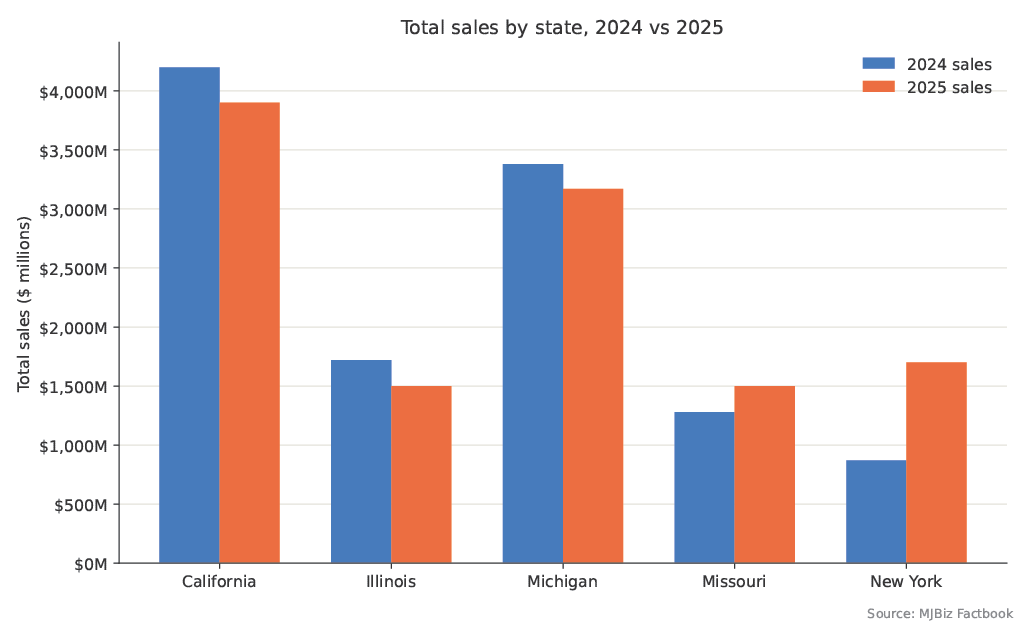
The data shows a widening divide between mature Western states and newer markets in the Midwest and on the East Coast.
What is cannabis price compression?
Michigan offers one of the starkest examples of price compression at work.
Sales fell 5.3% from a year earlier even though unit volume slipped just 2.1%. That’s a sign that consumers are still buying but at sharply lower prices, according to Parfitt’s analysis of sales figures from cannabis data platform Headset.
With an average item price of about $9.06, Michigan was the cheapest of the markets Parfitt analyzed, illustrating how badly margins have eroded.
Missouri and New Jersey tell a different story.
Missouri, still earlier in its development, posted a record $1.5 billion in sales last year. Meanwhile, the average item price held at $26.82, according to Parfitt’s analysis.
In New Jersey, unit sales climbed 8.8% while average item price stayed at $30.59, according to Parfitt’s analysis.
That means for opportunity, operators and investors should look away from the West.
“The greatest opportunity right now is in the Midwest and on the East Coast,” Parfitt said.
“Many of those markets still have room to bring consumers into the legal system, and they have not experienced the same degree of price compression, brand crowding and oversupply that we see in mature markets.”
Can state cannabis regulators help fix declining cannabis sales revenue?
Whitney and Parfitt, both of whom will speak at MJBizCon in December, blame regulators for the decline – specifically, the tendency to over-license markets relative to actual demand.
“Licensing is often driven by political goals rather than market economics,” Parfitt said.
States want tax revenue. Municipalities want fees and jobs. Applicants want to participate.
“Those are all legitimate considerations, but issuing more licenses does not create more consumers,” she said. “We have too many cultivation facilities, dispensaries, brands and products chasing the same demand.”
Whitney calls it “regulatory malfeasance,” an unintentional failure by regulators to manage supply and demand.
“They’re oversupplying the market, and prices fall,” he said, noting that in most states, licensed supply capacity already exceeds total in-state demand.
Are license caps the solution to the cannabis industry’s woes?
Parfitt said a balanced license count should be tied to market conditions: population, consumer participation rates, per-capita spending, tourism, illicit market activity, retail access and the cultivation activity already operating in the state.
“States should be able to pause licensing when capacity exceeds demand instead of continuing to add operators to an already crowded market,” she said.
She also cautions against the opposite extreme: Too few licenses can restrict access, keep prices artificially high and protect underperforming businesses.
“A regulator’s job should not be to guarantee that every operator succeeds,” she said. “It should be to create the conditions for a productive, competitive and sustainable marketplace.”
Why are cannabis retailers selling more product but making less money?
Some retailers reacted to the decline in sales with aggressive discounting. The result has been a record amount of product moved, but less dollars in the register.
In Michigan, for example, retailers reported $3.38 billion in sales revenue, on 291 million units sold. But in 2025, sales revenue dropped to $3.17 billion, even as the number of units sold increased to 348 million.
Dan Morgan, owner of Colorado-based Social Cannabis, has watched the cycle firsthand since entering the industry in 2010.
“Cutting prices too aggressively is the biggest mistake retailers make when prices fall,” he said, noting that a 25% price cut that doesn’t generate new customers simply results in a 25% cut in revenue.
Morgan also flagged hemp THC products as a threat to cannabis markets’ viability.
“Intoxicating hemp has really taken pretty dramatic market share from cannabis businesses,” he said.
Up until recent federal and state regulation, hemp products faced lower regulatory barriers and compliance costs than licensed cannabis operators, he added.
How the cannabis industry can solve its price compression crisis
Parfitt says the path forward comes down to the four Ps:
- Product
- Price
- Place
- Promotion
“There is only so much cost an operator can remove,” she said. “Eventually, continued price compression affects quality, service, innovation and the ability to remain in business.”
Mature markets can recover, but it requires consolidation, excess capacity exiting the market and supply coming back into alignment with actual demand.
Subscribe to the MJBiz Factbook
Exclusive industry data and analysis to help you make informed business decisions and avoid costly missteps. All the facts, none of the hype.
What you will get:
- Monthly and quarterly updates, with new data & insights
- Financial forecasts + capital investment trends
- State-by-state guide to regulations, taxes & market opportunities
- Annual survey of cannabis businesses
- Consumer insights
- And more!
Whitney sees some of that already happening. Licenses are being surrendered, operators are getting out, and the market is beginning to self-correct. But he said regulators must act faster.
Parfitt and Whitney both said that regulators must do more than continue issuing licenses. They must match supply to real demand and rethink a dispensary-only model that limits legal customer access.
“The industry cannot promote its way out of this problem,” she said. “We need to align supply with actual demand, stop racing to the bottom and focus on the one thing that can create sustainable growth – bringing more consumers into the category.”
Margaret Jackson can be reached at margaret.jackson@mjbizdaily.com.