Why More Cannabis and Hemp Retailers Are Adding 7-OH to Their Shelves in 2026
Walk into any well-stocked smoke shop, vape store, or hemp retailer in 2026 and you will see a category that barely existed three years ago. Refined 7-hydroxymitragynine products are sitting alongside CBD, delta 8, and traditional kratom on shelves across the country. The category, usually shortened to 7-OH, has quietly become one of the fastest-moving plant alkaloid segments in the United States.
For retailers and distributors evaluating product mix decisions for the second half of 2026, the case for adding 7-OH is straightforward. Customer demand keeps rising. Retail margins are healthy. And the regulatory environment, while still evolving at the state level, is far more settled than the chaotic early days of CBD or hemp-derived cannabinoids.
What 7-OH Actually Is
7-hydroxymitragynine is a naturally occurring alkaloid in the kratom plant. Found in much smaller quantities than mitragynine, the primary kratom compound, 7-OH is significantly more potent on a per-milligram basis. Modern extraction processes concentrate the alkaloid into refined tablets, liquid shots, disposable vapes, edibles, and powders that deliver predictable, lab-tested servings to consumers.
The category bridges the gap between traditional kratom and the cannabinoid market. Customers who already buy CBD, delta 8, or kratom from your shelves are increasingly asking about 7-OH by name. Brand recognition is building fast around premium names like 7Stax, Kream, Opia, and Pressd.

The Retail Opportunity
Retail margins on premium 7-OH products typically run forty to sixty percent above wholesale cost. Pack sizes range from single-count blister packs that hit accessible price points to bulk multi-counts that deliver real per-unit value for daily users. Inventory turns are fast in high-traffic locations, often two to four weeks on the most popular SKUs. That velocity makes 7-OH one of the few categories that pays for shelf space quickly rather than tying up working capital for months.
Six states ban kratom outright, and several counties maintain local restrictions, so retailers must confirm local compliance before stocking. Outside those jurisdictions, the category is open for sale to adult consumers, and most established brands publish third-party lab test results that satisfy state-level disclosure rules.
Sourcing Through the Official 7OH Marketplace
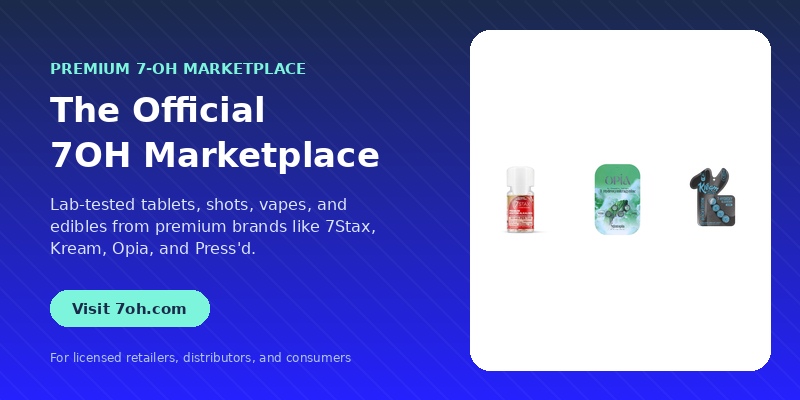
For retailers and distributors looking to source 7-OH at wholesale, 7oh.com is the official 7OH marketplace. The platform aggregates premium brand inventory under one roof, publishes third-party lab test results for every product, and runs a dedicated distributor program with tiered pricing for qualifying retailers and chain operators.
Minimum order quantities for new wholesale accounts typically start in the five hundred to one thousand dollar range, with deeper discount tiers unlocking at higher volumes. The catalog covers tablets, shots, disposable vapes, edibles, powders, and capsules across the major premium brand lines.
What to Do Next
If 7-OH is not yet part of your retail mix, the next ninety days are a good window to evaluate. Start with a small mixed wholesale order covering three to five brands across tablets, shots, and disposable vapes. Track velocity by SKU. Adjust your reorders to weight the products your customers actually return for. Customers are already asking. The question is just whether you stock the category first or watch competitors do it instead.