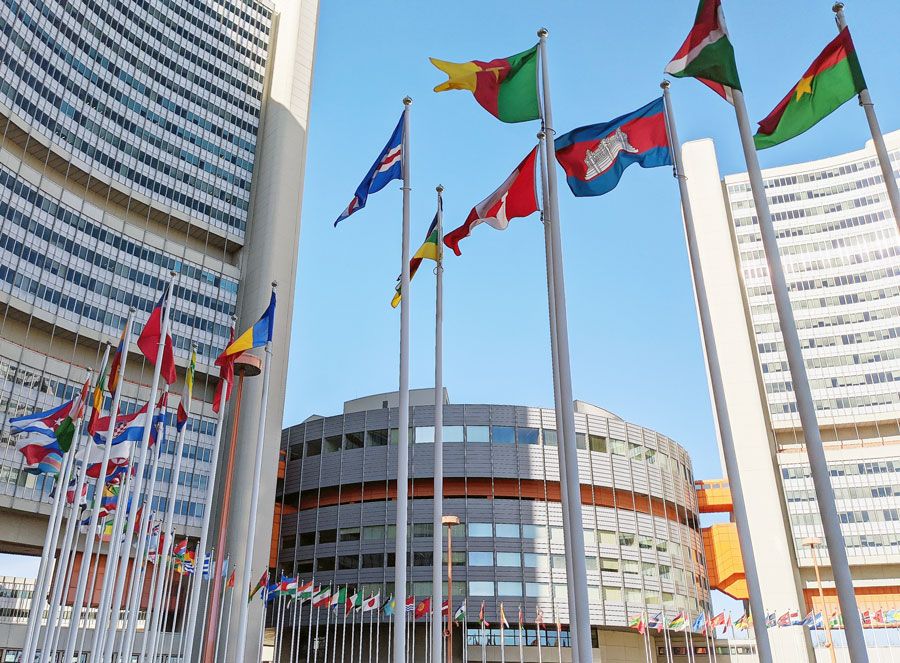
The 63rd session of the United Nations Commission on Narcotic Drugs (CND) in Vienna this week laid bare deep divisions in the international community over the World Health Organization (WHO) cannabis scheduling recommendations.
Rather than voting on recommendations that would have far-reaching implications for the global cannabis industry, the CND postponed the vote to December.
The delay underscores the difficulty in reaching agreements on cannabis policy on a level that transcends national borders.
“Medical cannabis is more mainstream than ever in places like Canada and the USA. However, internationally the challenge ahead for access becomes clear,” Michael Krawitz, executive director of Veterans for Medical Cannabis Access told Marijuana Business Daily.

The Michigan-based veterans organization helped coordinate civil society contributions to the WHO cannabis review process.
“Countries like Indonesia and Russia sound like North American drug warriors from back in the 1980s, and if the USA timeline works as a model, we are just beginning a decades-long process.”
Given the current level of disagreement, postponing the vote was the best outcome for the recommendations to stand any chance of approval.A forced vote this week would have likely resulted in a negative result.
“This is a very important but, at the same time, very sensitive issue because of the divergent opinions – not only among the states but among the people in general,” CND Chair Mansoor Ahmad Khan said.
It can be reasonably estimated that:
- About one-third of the CND voting members are fiercely against any change to the status quo on cannabis scheduling.
- Another third is still figuring out how to interpret the WHO recommendations.
- The rest of the members are ready to vote, but support is timid.
Realistic outcome
The CND chair said during the full session Wednesday that “it became clear that some delegations do not have a clear understanding on the implications and consequences of the recommendations, while others were already prepared to vote.”
During an informal dialogue Thursday, the CND chair said he “tried to work around to build a compromise which tries to balance these two positions.”
Tomas Sadilek, director of governmental affairs at the Prague-based International Cannabis and Cannabinoids Institute (ICCI) told MJBizDaily that pushing countries to vote could have resulted in an “irreversible negative outcome,” possibly even thwarting governments from enabling medical cannabis regulations.
Bringing undecided countries into the “pro-rescheduling” fold is no easy task.
“Many of Wednesday’s statements show that chances of approval in December still look slim,” Andres Lopez, former head of Colombia’s National Narcotics Fund, told MJBizDaily.
“There’s a big challenge ahead to in just a few months convince at least the undecided countries to support the recommendations.”
During the informal dialogue, the CND chair said that he would like to “hold some informal consultations … where legal and domestic experts from member states can come in.”
He indicated there could be “two or three meetings” before December “depending on the availability of resources.”
“So I hope that when we go into December more and more states have better clarity,” he said.
Wanted to vote
In their statements, some countries or group of countries expressed a somewhat favorable opinion about the recommendations or showed some willingness to vote.
Among their responses:
- The European Union regretted that “the majority of countries wasn’t ready” to vote, urging them to be ready in December.
- Other European countries, Mexico and Uruguay aligned with the European Union’s statement.
- South Africa said that “the recommendations are sound, balanced and based on the critical review of the scientific evidence” and that they “will serve as an important guide on how member states should schedule the substances under domestic legislation.”
- Jamaica showed concern that “continuing delay will not improve access and enhance palliative care for those individuals who are suffering” from various illnesses.
- In Canada‘s opinion,“two recommendations were ready for a substantive vote and could have been adopted today,” but “in the spirit of compromise we were willing to postpone voting.”
- Mexico said failing to act on the recommendations “would mean shrinking our role as the principal organ to address the world drug problem.”
- Switzerland “was prepared to vote,” adding it “regret(s) that some member states were not.” Switzerland’s representative said “we need to show the world … that international scheduling system is credible and fit for the future.”
- The U.S. called “differences in national situations” and “viewpoints” an “important part” of the process and urged others to use the next months “productively” to be ready to vote in December. Its representative reminded that the recommendations “reaffirm the placement of cannabis under Schedule 1 of the Single Convention” to which “the strictest set of controls” apply and called this a “milestone in our collective efforts to control narcotic drugs liable to be abused but also possessing the potential of therapeutic value.”
- The United Kingdom said it was “ready to vote … but respect the consensus decision … to postpone,” calling a December vote “imperative … to preserve the integrity and credibility of the international scheduling system.”
Mostly against
The countries that expressed opinions against voting now and, in some cases, also against the recommendations represent the vast majority of the global population, revealing the uphill battle ahead for the normalization of the medical cannabis industry.
A common theme expressed by several countries – including Russia, Nigeria, Japan, Sudan, Brazil and Palestine – was the “social, legal, administrative” and other types of implications of the WHO recommendations.
Here are responses from some of the countries with negative views:
- Russia was pleased with the postponement, saying it has not seen any “convincing argument” to support the recommendations, calling cannabis “the most abused drug in the world.”
- Singapore said the recommendations would have “the overall effect of significantly loosening the stringency of international control over cannabis,” leading to a “widening of public access to cannabis” that could “cause serious public health and safety issues.” Moreover, Singapore does not “see any strong evidence to substantiate the recommendations,” nor does it believe any change is needed to allow medical and scientific use. Its representative said “the current international drug control regime already allows more than adequate access to drugs including cannabis for medical and scientific use,” worried that “the public may be misled into thinking cannabis is no longer assessed to be harmful.”
- Japan said “the unity of all member states working against drugs would be the most important thing to keep,” welcoming the postponement.
- China hoped “the WHO will continue to strengthen its research on the dangers and risks of abuse of cannabis.”
- Nigeria expressed “serious concerns” and believes “the reasons … for the recommendations are insufficient.” Its representative was “deeply concerned about the global perception,” because adopting the recommendations “may be viewed as support for legalization of nonmedical cannabis.” He also linked cannabis “abuse” to “crime, including insurgency and banditry in Nigeria,” calling cannabis “the most abused substance in the world.” He emphasized that “a hasty decision on the rescheduling of cannabis will have disastrous consequences.”
- Egypt said the recommendations “need to be debated combined” without “singling out” any of the six.
- Iran welcomed the postponement, calling the evidence presented for the recommendations “inadequate,” “inconclusive” and “not well defined” and the implementation “may lead to confusion.”
- Kenya was thankful for having “more time,” and said adopting the recommendations would “result in uncontrollable abuse and misuse of cannabis.”