
The Trump administration rescheduled medical cannabis and is entertaining a Biden-era proposal to reclassify all marijuana as a medicine only because of political considerations, including campaign donations, a prominent reform opponent claimed Monday.
The allegation came on the first day of U.S. Drug Enforcement Administration hearings called to consider reclassifying marijuana as a Schedule 3 drug from Kevin Sabet, CEO and president of Smart Approaches to Marijuana, one of the “interested parties” participating in the hearing.
Monday was the first day of testimony before the DEA’s top administrative law judge.
The U.S. government is in the unfamiliar position of defending its proposal that “marijuana” as defined under federal law be reclassified a Schedule 3 drug, a classification reserved for substances with medical value and some potential for abuse.

And the government is doing so “because of a political reason,” Sabet said in a video posted to X.
He added: “Because of donations from people like (Trulieve Cannabis Corp. CEO) Kim Rivers, who donated to inaugural committees and MAHA PACs, etc., solely because of that reason, you now have the government in the super-awkward position of arguing the opposite of what it’s been arguing for the past 50 years.”
Did Trump reschedule marijuana because of campaign contributions?
Sabet appeared to post his video during a scheduled lunch break called during testimony from the government’s witnesses.
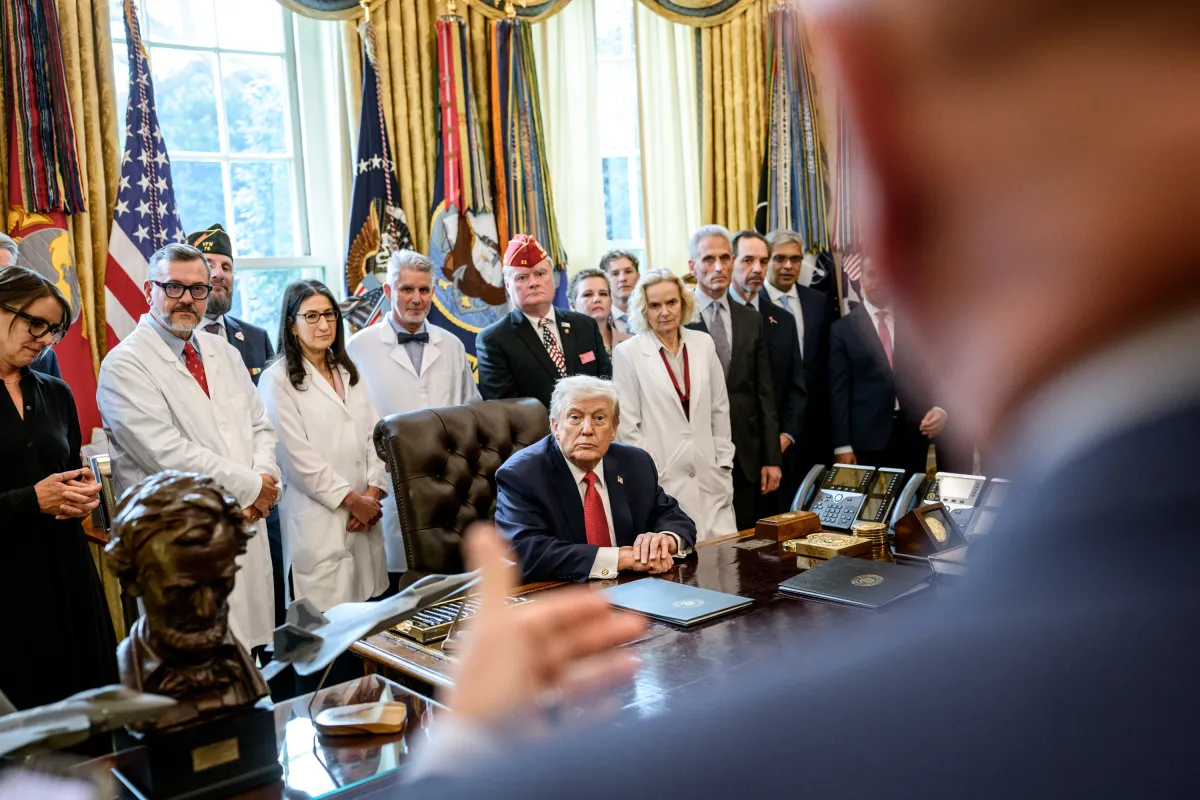
Rivers, whom Forbes called “the Trump whisperer” in an April profile of the executive, was at the Oval Office on Dec. 18 when President Donald Trump issued an executive order that directed the Justice Department to finish the marijuana rescheduling process.
Rivers and Charlie Bachtell, the CEO of multistate operator Cresco Labs, both attended Trump’s January 2025 inauguration.
And both companies contributed to a political action committee called American Rights and Reform, which in turn donated $2 million to Trump’s MAGA Inc. in 2025.
However, it’s doubtful whether Sabet’s argument will carry any weight in the DEA hearing – whether it will be heard at all.
Instead, the hearings focused on matters of policy and medicine.
What happened during the first day of DEA marijuana rescheduling hearings?
According to law firm Vicente LLP, the Trump administration’s witnesses are:
- Dominic Chiapperino, the director of the Controlled Substance Staff at the Food and Drug Administration’s Center for Drug Evaluation and Research. Chiapperino was responsible for the novel two-factor test that the federal Department of Health and Human Services used in August 2023 to determine whether cannabis has a currently accepted medical use in the United States.
- Dr. Corey Burchman, a professor at the Geisel School of Medicine at Dartmouth College in New Hampshire. He’s expected to testify that medical cannabis is an effective pain treatment.
Opponents such as SAM’s Sabet will have the opportunity to cross-examine both witnesses.
Testimony from both was expected Monday, with cross-examination scheduled Tuesday.
According to Vicente, the opponents’ witnesses are expected to be:
- Bertha Madras, a professor of psychobiology at Harvard Medical School and former official at the White House Office of National Drug Control Policy. Madras testified in favor of keeping cannabis a Schedule 1 drug as a government witness in 2014, who will testify on behalf of Sabet’s SAM.
- Dr. Deepak Cyril D’Souza, a professor of psychology at Yale University who oversees the Yale Center for the Science of Cannabis and Cannabinoids and is the editor of “Marijuana and Madness,” a book in its third edition.
- Sheriff William Honsal of Humboldt County, California. Honsal and D’Souza will testify on behalf of the states of Nebraska, Indiana and Idaho
- The National Drug and Alcohol Screening Association’s Executive Director Jo McGuire, who has lobbied for employers’ rights to deny jobs to cannabis users.
Subscribe to the MJBiz Factbook
Exclusive industry data and analysis to help you make informed business decisions and avoid costly missteps. All the facts, none of the hype.
What you will get:
- Monthly and quarterly updates, with new data & insights
- Financial forecasts + capital investment trends
- State-by-state guide to regulations, taxes & market opportunities
- Annual survey of cannabis businesses
- Consumer insights
- And more!
Federal law means the government must have made three findings to justify cannabis’ reclassification to Schedule 3:
- A currently accepted medical use in the U.S.
- An abuse potential lower than that of drugs in Schedules 1 and 2
- A risk profile of moderate to low physical dependence or high psychological dependence