
Editor’s note: A revenue figure in this article has been removed pending verification of third-party sourcing.
It’s no longer enough to slap a celebrity’s name and face on a generic jar of cannabis for operators to sit back and watch sales soar.
Over the past three years, brands linked with famous personalities who also evoke cannabis culture have gradually but steadily outsold other celebrity cannabis brands, national sales data shows.
“What is common among all the successful celebrity cannabis brands is how the celebrities are linked to the culture, and they’re focused on capturing the core consumer: the male smoker,” Mitchell Laferla, senior data analyst at Headset, told MJBizDaily.

What are the most successful celebrity cannabis brands?
As MJBizDaily reported, as recently as 2023, cannabis companies were pushing diverse portfolio of celebrity-backed brands. Famous names and faces included rapper and mogul Jay Z and singer Justin Bieber.
Today, “we don’t see those brands anymore as this area of the cannabis industry has thinned out as the market has constricted,” Laferla said.
But overall, celebrity appeal continues to move the U.S. cannabis market, according to a Headset analysis of 5,791 brands based on consumer transactions at retail partners.
Eight of the top-selling U.S. celebrity cannabis brands outsold traditional cannabis brands in 2025. What’s kept certain brands at the top of the list year after year is the celebrity’s association with cannabis, and how passionate they are for the product, Laferla said.
In the lead is Cookies, which has the distinction of being a brand driven by a cannabis celebrity, rather than a mainstream celebrity attempting to sell cannabis.
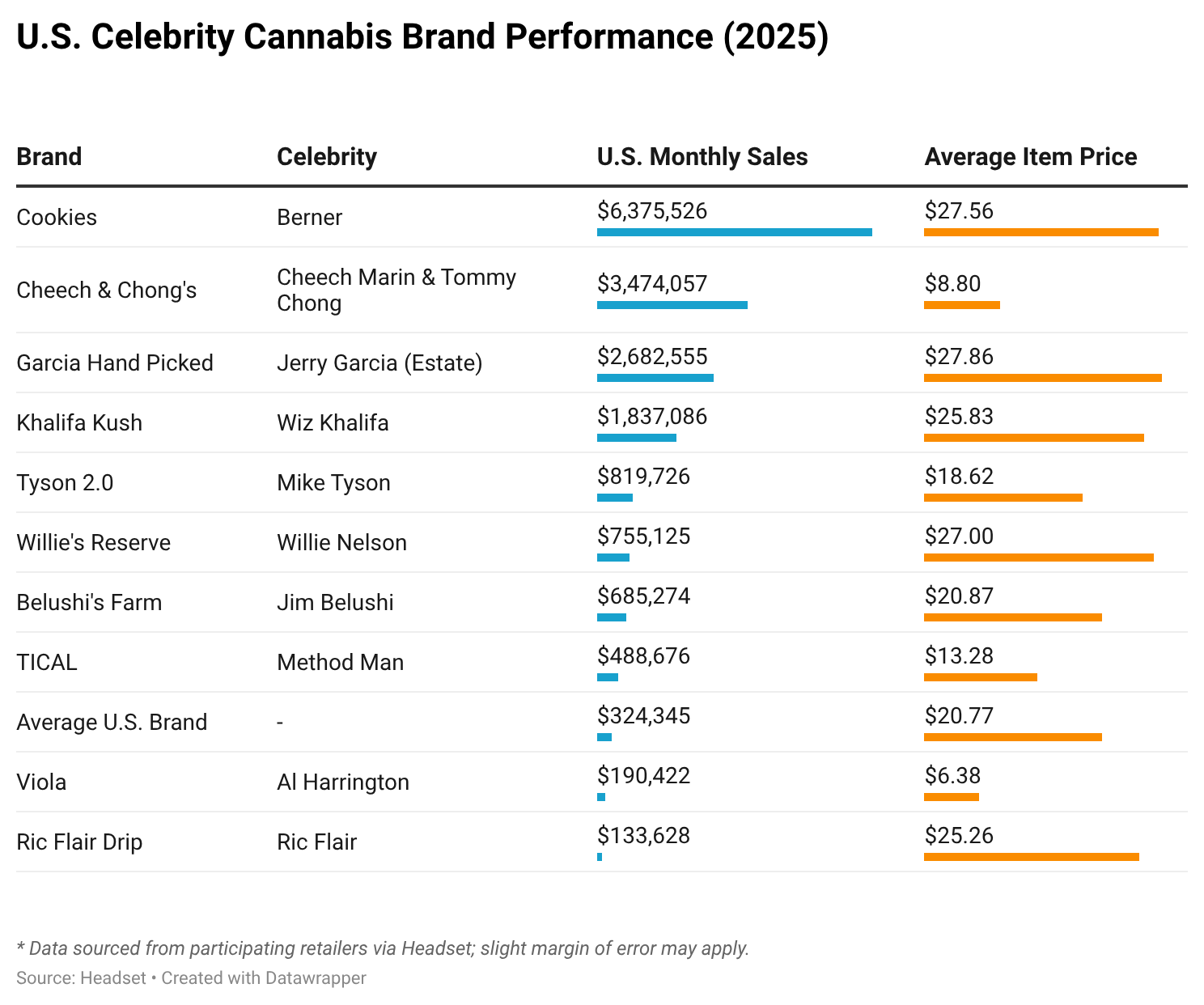
Cofounded by San Francisco rapper and entrepreneur Berner and sold throughout the country via licensing deals, Cookies recorded an average of $751,000 in monthly sales across all their operational states, according to Headset.
Celebrity cannabis brands joining the top 11-list of sales by revenue include Cheech & Chong’s, Garcia Hand Picked, Khalifa Kush, which launched in 2015, and Tyson 2.0, a brand debuting in 2021.
Most of these names are associated with cannabis culture, a key characteristic to perform strongly in a tight sector, Laferla said.
Is celebrity cannabis immune to price compression?
These brands also appear more resistant to the price compression plaguing operators across the country.
As per Headset, seven of the top 13 celebrity brands command a higher average-item price than traditional cannabis brands. Compared to the national average-item price of $20.77, Garcia’s Hand Picked was the highest at $27.86, followed by Cookies ($27.56) and Willie’s Reserve ($27).
But what still matters most, no matter whether the business links arms with celebrities or not, is distribution.
Cookies is the most widely distributed brand on the list in terms of available markets, Laferla said. And more doors lead to more sales, Laferla said.
Cookies “has become so well-known that it has outgrown its association with Berner,” he added. “Many consumers likely recognize and respect the brand independently of its ties to a public figure.”
As a general matter, US consumers still find celebrity-endorsed brands more attractive, according to a 2023 Nielsen report across multiple non-cannabis brand verticals. Celebrity-endorsed products saw a 29% average increase in “purchase intent” among consumers aged 18 to 34 compared to non-endorsed products.
It’s a figure that doesn’t surprise some brand managers in the cannabis space.
TICAL, an acronym for “taking into account all lives,” is the name of Wu-Tang clan rapper Method Man’s 1994 solo debut. And TICAL the cannabis brand benefits, said Nick Ave, general manager of Netherlands-based e-commerce shop Just Amazing, which manages TICAL’s sales in U.S. and Europe.
“Method Man is the OG of cannabis, you know he likes to smoke, and consumers connect with him,” Ave told MJBizDaily.
“And after all, he’s the co-founder of Wu-Tang. That’s pretty cool.”
Celebrity cannabis came from the COVID-19 pandemic
Celebrity-aligned cannabis brands boomed during the pandemic – an opportunity borne out of boredom and the COVID-19 pandemic era cannabis sales spike.
“No one could tour, cannabis was one of the few sectors doing well during COVID, and artists saw an opportunity,” Laferla said.
Celebrities rushed to enter the space. But to some industry observers, the trend felt forced – and premature.
Unlike other products, cannabis is subject to strict limits on advertising. That extends to social media.
Accounts cannot show people using the product. Nor can they be seen to be promoting sales, though “educational content” is accepted. As many have found, threading that needle often leads to a deactivation.
Having a celebrity promote a product through branding was seen as a way around these pitfalls, said David Paleschuck , author of Branding Bud: The Commercialization of Cannabis.
“We saw how all that red-tape, and unpredictability of what social media sites could do to your content, encourage brands to bring in celebrities to help endorse their brand, almost as if that was the default reaction,” he said.
But brands that partnered with a celebrity who lost interest in marketing the product have suffered. When celebrities don’t continue to promote their cannabis brand or show up for events, sales suffer.
“Celebrities are busy, they don’t have as much time as the brand may want,” he said.
To succeed, “A celebrity-endorsed cannabis brand needs to be consistent and deliver on the promise, and make sure the celebrity is truly on board,” he added.
Subscribe to the MJBiz Factbook
Exclusive industry data and analysis to help you make informed business decisions and avoid costly missteps. All the facts, none of the hype.
What you will get:
- Monthly and quarterly updates, with new data & insights
- Financial forecasts + capital investment trends
- State-by-state guide to regulations, taxes & market opportunities
- Annual survey of cannabis businesses
- Consumer insights
- And more!
Will there be more celebrity cannabis brands in 2026?
One way to do that is to ensure the endeavor is “authentic,” but that’s an ambiguous and elusive quality.
A good brand will have “a clear narrative and is purpose-driven,” musician Vic Mensa, founder of the 93 Boyz cannabis brand, told MJBizDaily.
But, he cautioned, the product inside the jar or bag also has to be good.
Consumer sensibility can’t be discounted. The public can sense when a celebrity just wants to cash out, Leferla said. Seth Rogen’s Houseplant, for example, does well because Rogen is a known and vocal regular cannabis consumer.
Success means more celebrities are likely to try their luck. The monthly sales for Belushi’s Farm, comedian and actor Jim Belushi’s brand, is double the national average. And the brand showed “a notable upward trajectory in brand ranking” through the latter part of 2025, according to a separate Headset analysis.
More celebrities like Belushi will enter the space – not because he’s a stoner icon, but because “he has a appreciation for the plant, and consumers can see that genuine passion,” Leferla said.
But going forward, fewer brands will push more marketing dollars into celebrity endorsements, he predicted.
That’s because rather than bet on a celebrity consumers don’t associate with cannabis, c-suites may prefer widening distribution to as many states as possible, before deciding on a partnership that doesn’t guarantee success.