
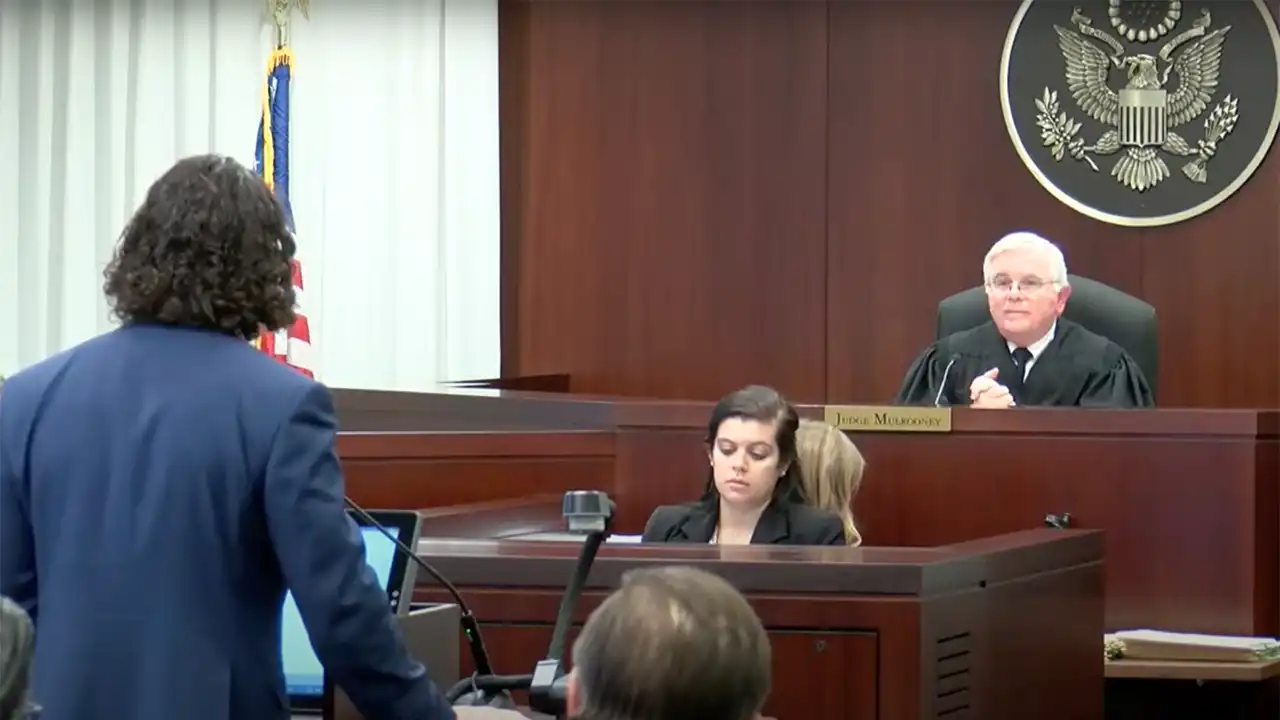
Legal, regulated cannabis is a positive for law enforcement, and most of the California cannabis diverted to other states comes from unlicensed, unregulated sources, the U.S. Drug Enforcement Administration’s chief administrative law judge heard during testimony on Wednesday, MJBizDaily has learned.
These revelations came on the final day of highly anticipated DEA marijuana rescheduling hearings, which concluded Wednesday, from Humboldt County, California, Sheriff William Honsal, according to attorneys from cannabis-focused law firm Vicente LLP, which had representatives present in the DEA hearing room in Alexandria.
The Humboldt County Sheriff’s Office did not respond to several requests for comment regarding Honsal’s appearance or his testimony, which he gave as a witness on behalf of three states officially opposing marijuana rescheduling.
It’s still unclear why the states tapped Honsal or what arrangements Indiana, Idaho and Nebraska authorities made to bring the California lawman to Washington to speak on their behalf. About 1 million pounds of cannabis are legally produced in Humboldt County every year, according to a state Department of Cannabis Control Harvest Report.

California did not participate, nor did any other state or party in support of rescheduling.
But Honsal’s ultimately encouraging words – given during cross-examination by Justice Department attorneys – added to the past two weeks of testimony both in support and against the Biden administration-era proposal to downgrade all marijuana as defined under U.S. law to a Schedule 3 drug, are leading advocates to predict that marijuana rescheduling will happen, observers told MJBizDaily.
Will the Trump administration reschedule marijuana?
“The result of the hearing is pretty clear, based on the proceedings,” said Shawn Hauser, a Texas-based partner at Vicente.
Marijuana rescheduling is justified on both “the law and the science,” she told MJBizDaily.
It’s not clear when DEA Chief Administrative Law Judge Derek Julius will issue a final ruling. Notably, his ruling is not binding – and there’s no time frame for when DEA Administrator Terence Cole or Acting Attorney General Todd Blanche, who signed off on April’s final rule reclassifying state-licensed medical cannabis, will issue a final rule.
For now, cannabis rescheduling is limited to medical marijuana operators – two of which, Florida-based Trulieve Cannabis Corp. and California cultivator Glass House Brands, uplisted to the New York Stock Exchange after registering with the DEA.
But observers say a theme emerged over the past two weeks of hearings.
Most of the testimony from marijuana rescheduling’s opponents did not seem intended to sway the administrative hearings, called to consider the May 2024 proposal to reclassify marijuana as defined under U.S. law as a Schedule 3 drug, down from Schedule 1. An April final order has already rescheduled cannabis produced under a state medical marijuana framework.
Instead, with witnesses harping on the issues of diversion and health risks rather than the seemingly central question of whether marijuana has a “currently accepted medical use” in the United States, it appeared opponents’ main objective during the hearings was to put evidence on record that could be used in a later, separate lawsuit challenging whatever final rule emerges.
Smart Approaches to Marijuana, a prominent anti-reform group that’s also bankrolling measures that would recriminalize adult-use sales in two states, “and opponents were likely establishing a record for their appeal, rather than providing arguments to influence the ALJ’s decision,” said Paul Armentano, deputy director at the National Organization for the Reform of Marijuana Laws (NORML).
NORML was denied participation in the hearings.
What’s next for marijuana rescheduling?
Honsal’s appearance had initially sown confusion and suspicion among cannabis businesses in Humboldt County, which had roughly 1,000 licensed cannabis cultivators as of about a year ago.
That’s in part because Honsal has “a long history of making pro-legalization statements,” said Ross Gordon, policy director at the Origins Council, an advocacy group for small cultivators in California’s Emerald Triangle, who spoke with MJBizDaily before Honsal’s day at the marijuana rescheduling hearings.
The absence of a pro-cannabis voice in the proceedings led some observers to fear a tepid defense or, worse, a political hatchet job. (Fears of DEA resistance helped thwart prior hearings paused and ultimately canceled as Trump took office for a second term).
But according to Hauser, both the government’s preparation and its willingness to challenge the “interested parties” claiming to suffer harm thanks to relaxed federal restrictions on cannabis suggest the Trump administration intends to move relatively quickly – and to act decisively and issue a final rule reclassifying all marijuana as a Schedule 3 drug.
“These processes can take years and years, but these have been expeditious from the start,” she said, noting that the Justice Department appears to have acted on President Donald Trump’s December executive order to finalize cannabis’ reclassification “in the most expeditious manner possible.”
Prior reclassification efforts have taken years, though those weren’t initiated by the government.
Subscribe to the MJBiz Factbook
Exclusive industry data and analysis to help you make informed business decisions and avoid costly missteps. All the facts, none of the hype.
What you will get:
- Monthly and quarterly updates, with new data & insights
- Financial forecasts + capital investment trends
- State-by-state guide to regulations, taxes & market opportunities
- Annual survey of cannabis businesses
- Consumer insights
- And more!
Will the Trump administration defend marijuana reform?
Wednesday’s final day of hearings also included testimony from Yale University psychiatry professor and physician Dr. Deepak D’Souza, who testified about cannabis’ links to mental illness, including schizophrenia.
But like other witnesses, D’Souza’s testimony did not seem to challenge or even address the core argument: whether cannabis can be deemed to have a currently accepted medical use and whether the government’s new analysis to determine medical use is consistent with federal law and procedures – and, on top of that, complies with the U.S.’s obligations under international drug-control treaties.
Observers said the hearings could shed light on what arguments opponents may use during future lawsuits. If so, for the most part, they’re “pretty weak,” Hauser said.
And to counter that, the hearings indicated “a strong government partnership” in defending the proposed rule, with representatives from both the Department of Health and Human Services and the Justice Department, including the DEA, “putting forth arguments for rescheduling and acknowledging medical use,” she added.
Chris Roberts can be reached at chris.roberts@mjbizdaily.com.