
For years, much of the medical cannabis industry focused on one problem: access. Build the appointment flow, connect patients with practitioners, simplify registration, and remove unnecessary travel. That work mattered. But in 2026, access alone is no longer enough to distinguish a credible program. The new bottleneck is clarity.
Patients do not enter medical cannabis programs with a single question. They arrive with a chain of them: Do I meet my state’s rules? What happens during an evaluation? Is registration separate from certification? What documents are required? How long is certification valid? What can I legally purchase, possess, or transport? Because every state structures its program differently, a generic national FAQ can create more confusion than confidence.
This is where patient education becomes more than a support function. It becomes infrastructure.
For providers, clear pre-appointment guidance can reduce avoidable scheduling questions, help patients bring the right information, and keep consultations focused on the practitioner’s role rather than administrative cleanup. Regulators and dispensaries also benefit when patients reach the point of purchase with a clearer understanding of program rules. For the patient, the process feels less like navigating a maze and more like following a defined sequence.

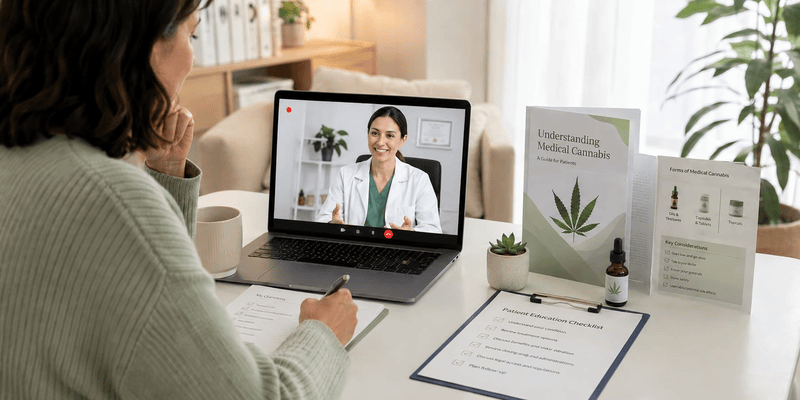
Telehealth strengthens this model, but only where state rules permit remote evaluations. The strongest platforms do not treat the video call as the entire service. They build education around it: plain-language eligibility pages, state-specific checklists, renewal reminders, portal guidance, and clear explanations of what certification does and does not provide.
Importantly, education should not become a library of generic articles. The useful unit is the next decision: whether to book, what to prepare, which portal to use, when to renew, and what rules apply after certification. When each page answers one high-intent question, the content serves patients and operations at the same time.
Virginia illustrates why that precision matters. Consumers commonly search for a “card,” even though the current program centers on a written certification and digital validation rather than a mandatory state registration card. CannabisMD TeleMed addresses that gap with a clear explanation of the Virginia medical marijuana card requirements and a step-by-step overview of the medical marijuana certification process. Together, these resources help distinguish practitioner evaluation from state and dispensary procedures.
That distinction is not semantic. It is operational.
As medical cannabis programs mature, providers will compete less on who can place a booking button in front of a patient and more on who can remove uncertainty at every step. The organizations that explain the process accurately, update guidance as rules change, and avoid overstating what certification guarantees will earn something harder to copy than speed or price: trust.
In 2026, patient education is not extra content. It is the user experience, the compliance layer, and one of the most defensible advantages a medical cannabis provider can build.